PharmaceuticalMixing & segregation
Does the blend segregate in a commercial-scale tablet press feed system?
Pfizer used a coupled CFD-DEM model of the full feed system.
Case studies from pharmaceutical, mining, iron and steel, agricultural machinery, process, and battery manufacturing, modeled with Aspherix® and CFDEM®coupling.
How Aspherix® and CFDEM®coupling solve real particle process questions, from tablet presses to blast furnaces. Filter by industry or process and open a card for the details.
Industry
Process
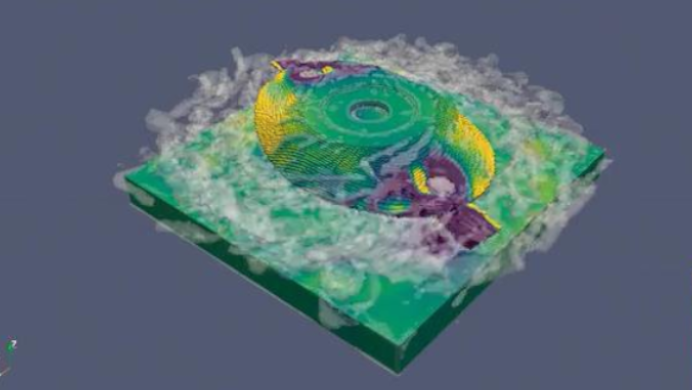
PÖTTINGER and DCS Computing simulated the air flow in a mower deck whose blades sweep overlapping paths, compared design variants for better cut quality, and modelled grass as flexible fibres.
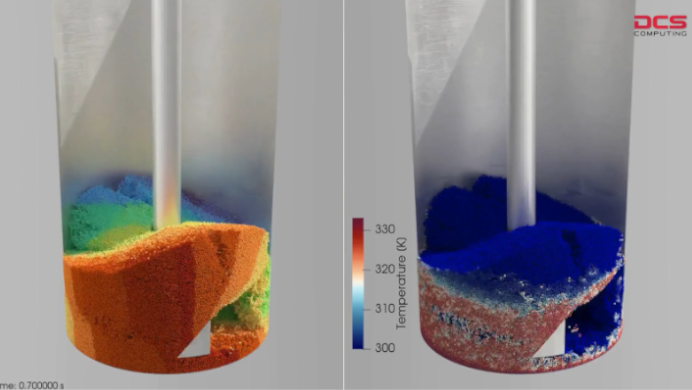
A wet cake whose cohesion changes as the solvent evaporates in a heated filter dryer.
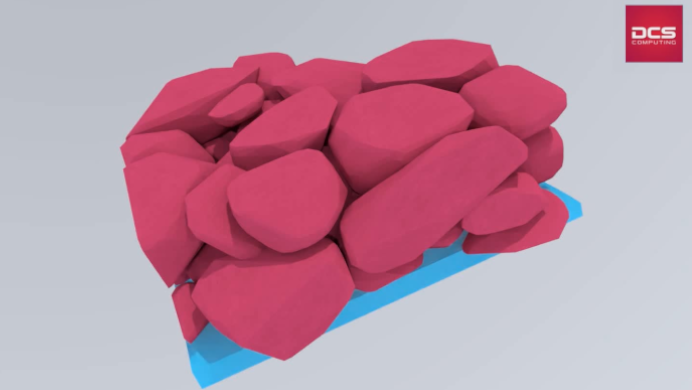
Liquid flow through granular beds with convex particles to find trapped air pockets.
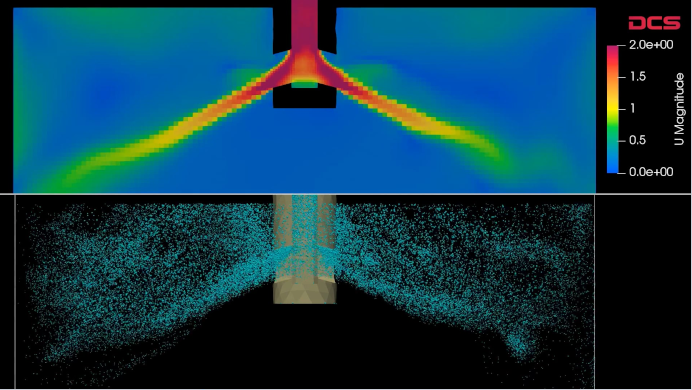
Where argon bubbles and inclusions end up, to reduce slab surface defects.
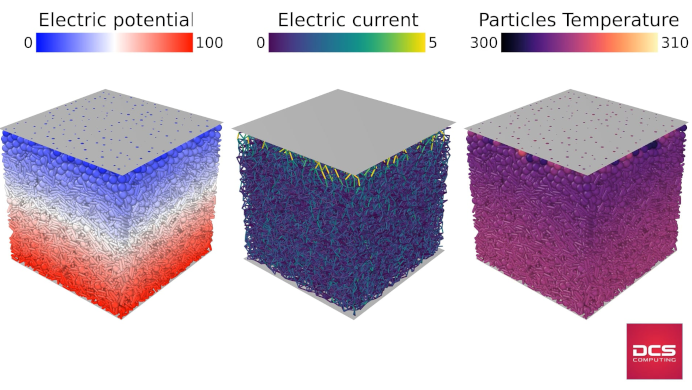
Electrode paste particles heating up under electric current.
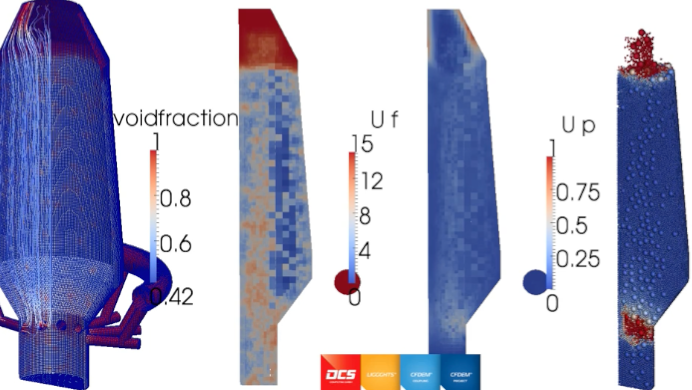
Burden distribution, gas flow, heat and mass transfer and melting inside a blast furnace.
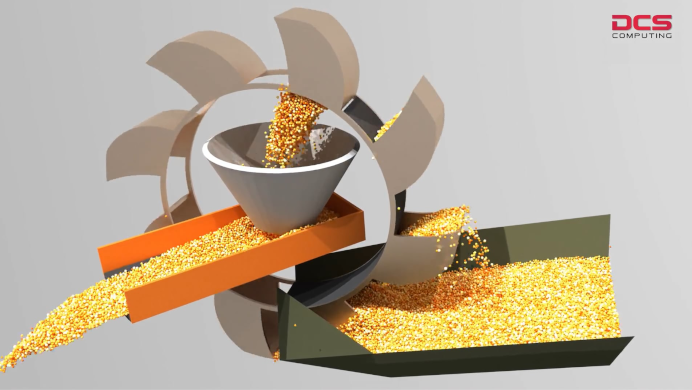
Cohesive, polydisperse material fed through a funnel onto a sloped conveyor.
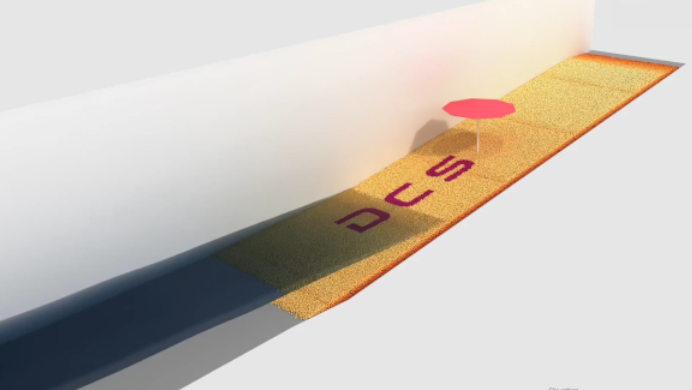
Wave-driven sand transport and beach change, including movement below the surface.
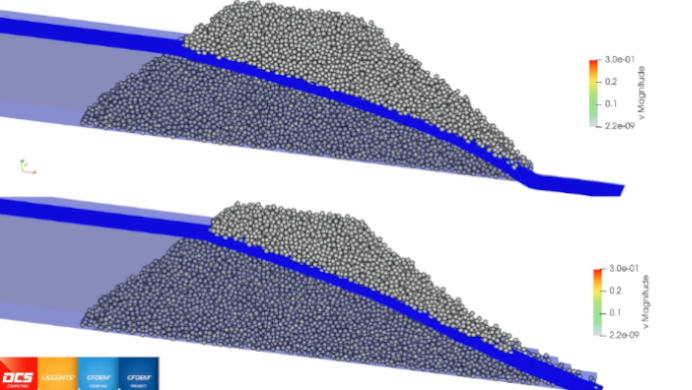
Conceptual study: how rising water levels reduce dam stability.
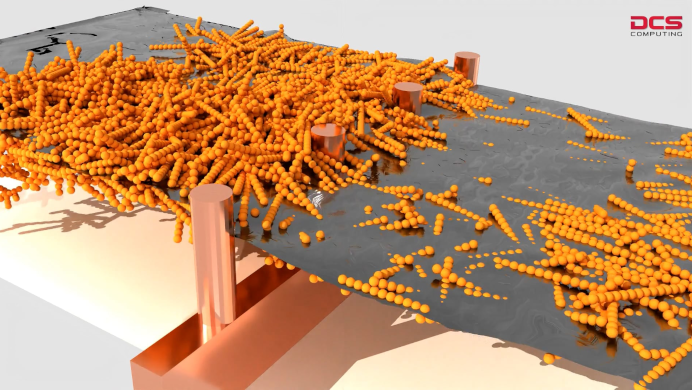
Floating logs and clogging at weirs, multisphere particles coupled with free-surface water.
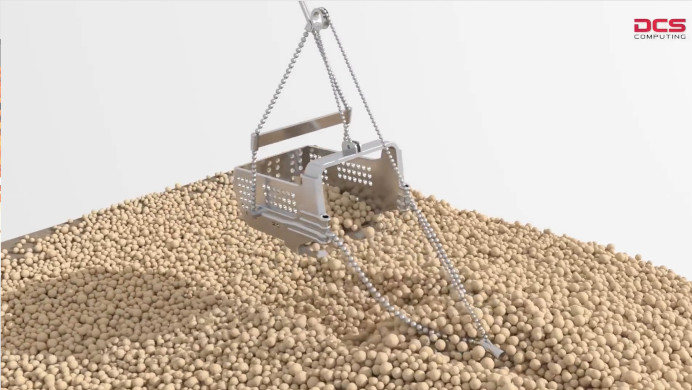
A dragline bucket digging gravel, with ropes and chains modelled as bonded particles.
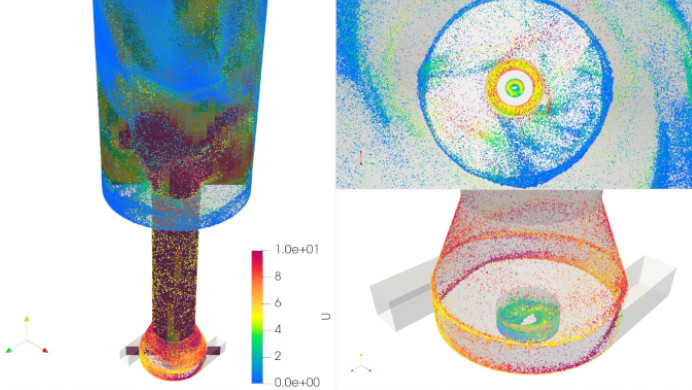
Release of active ingredient from carrier particles in four-way coupled CFD-DEM on GPU.
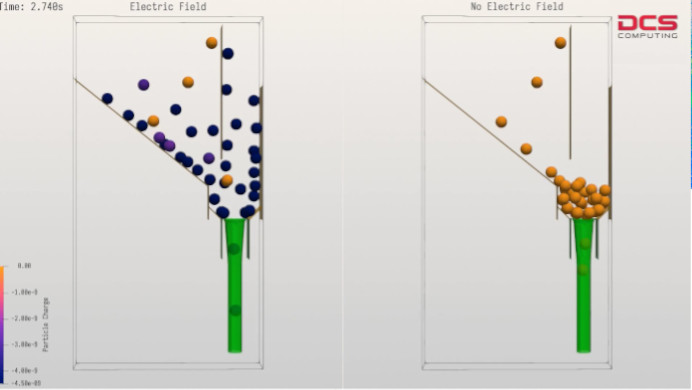
Triboelectric charging and electrostatic forces in hoppers, to reduce clogging.
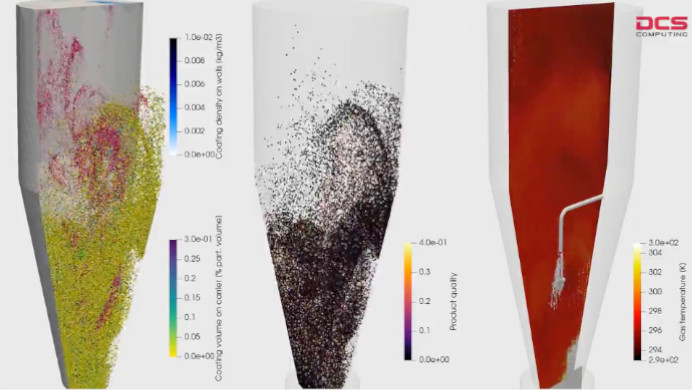
Spray granulation with coating level and temperature followed in fully coupled CFD-DEM.
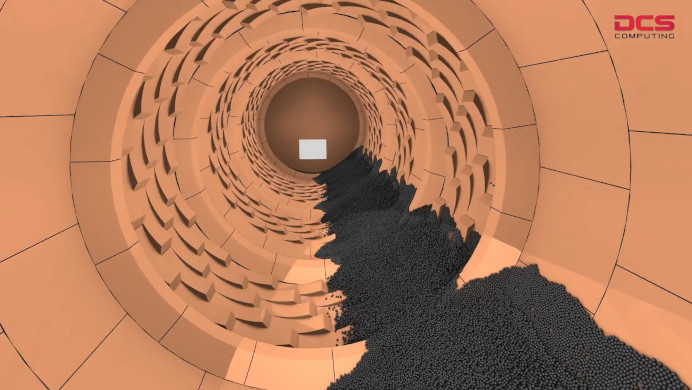
Mixing efficiency and residence time distribution in a full-scale rotary kiln.
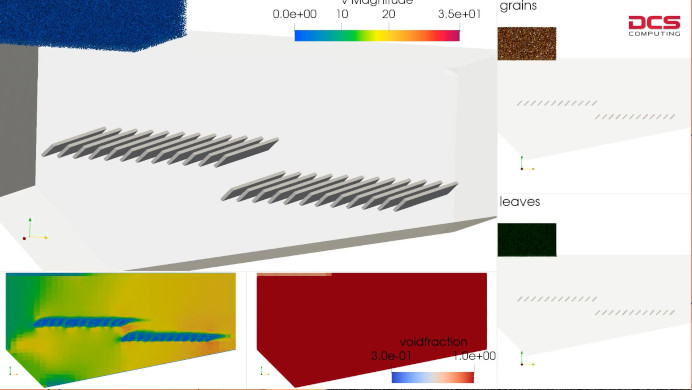
Grain separation over a moving chaffer with immersed boundary CFD-DEM on GPU.
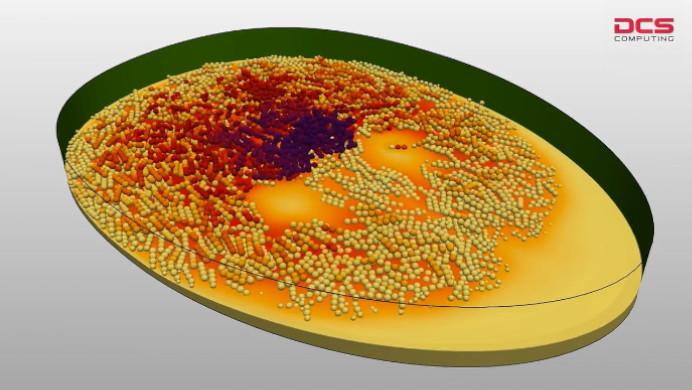
Melting of HBI at the slag-steel interface under magnetic stirring, with mass loss tracked.
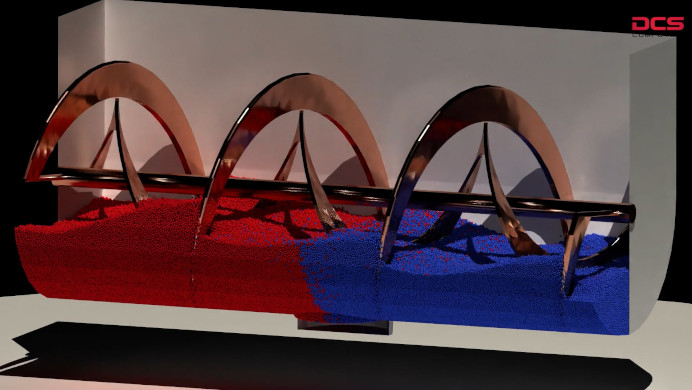
Blend homogeneity and energy use of a helical mixer with over a million multi-sized particles.
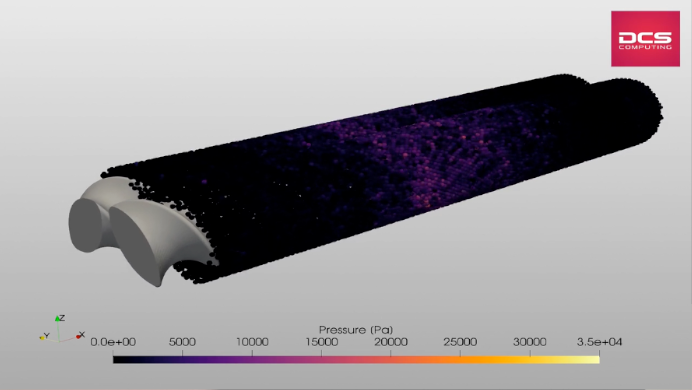
DEM representative volumes linked to a low-order twin-screw extruder model.
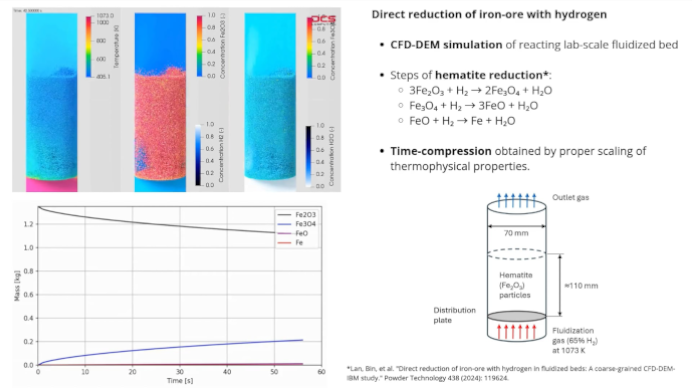
Hematite reduction with hydrogen in a fluidized bed, with chemical kinetics in CFD-DEM.
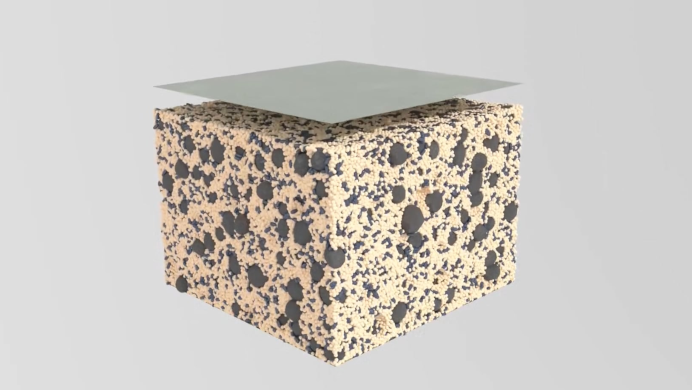
Bonded active and additive particles; the layer gets about 30% thinner during calendering.
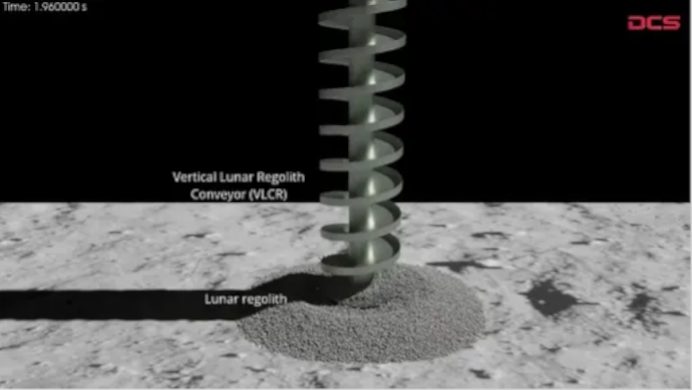
Stick-slip behaviour of non-spherical regolith in a lunar conveyor.
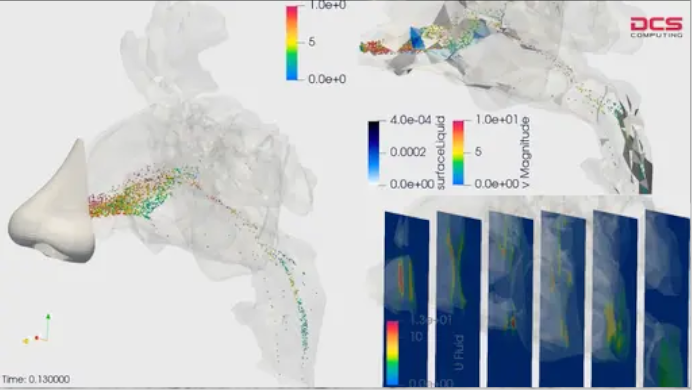
Evaporating droplets tracked through the nasal airways in a pre-computed air flow.
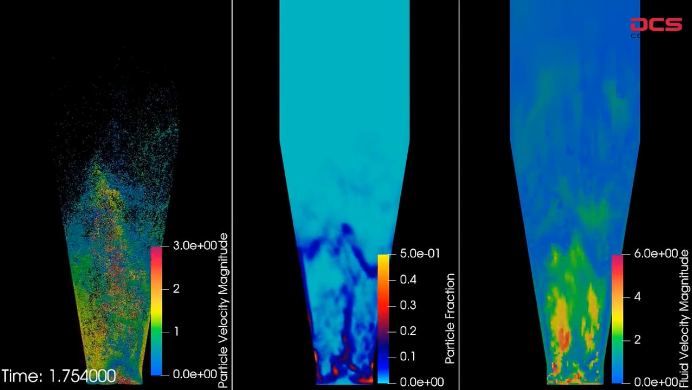
Fine powder fluidization in large batch equipment, accelerated on GPU.
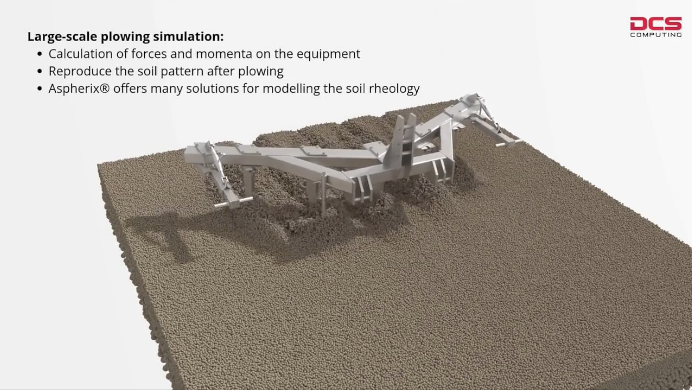
Soil–tool interaction and plough wear predicted with calibrated soil parameters.
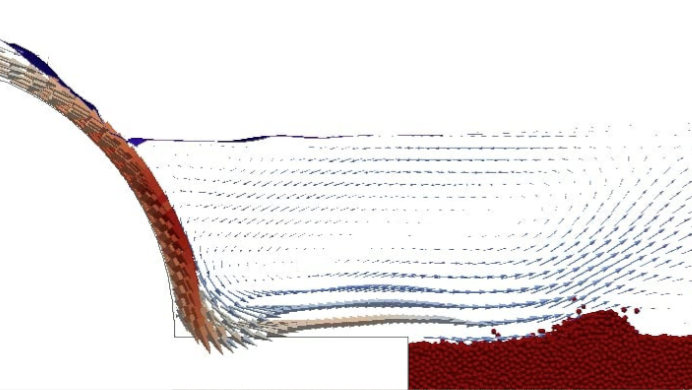
Forces on single sediment particles under changing flow, with VoF and DEM coupled.
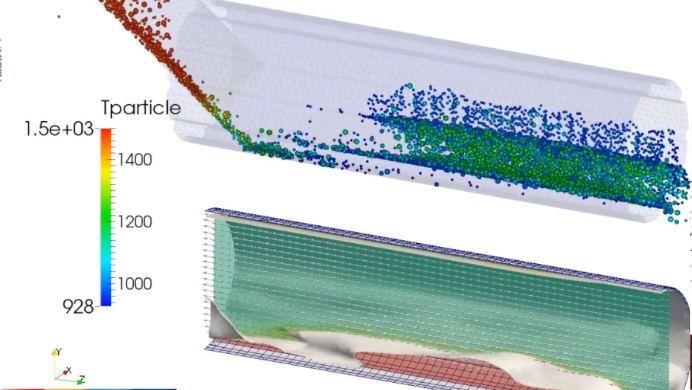
Heat transfer from hot particles moving through a rotating, inclined cooler.
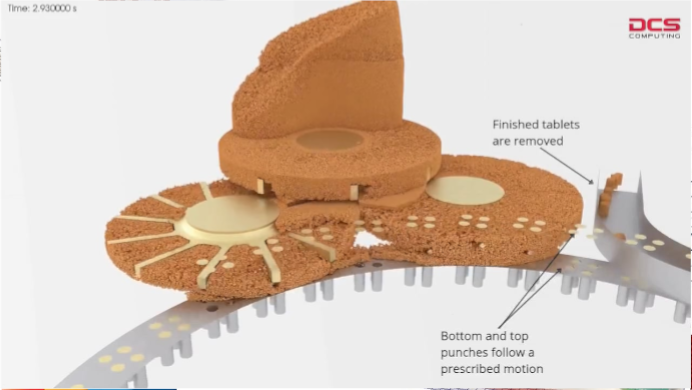
Die filling, compaction density and tablet defects predicted with calibrated DEM.
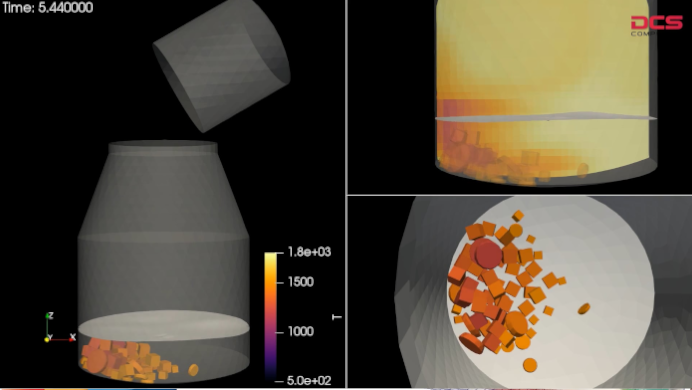
Scrap charging and melting in a hot metal bath.
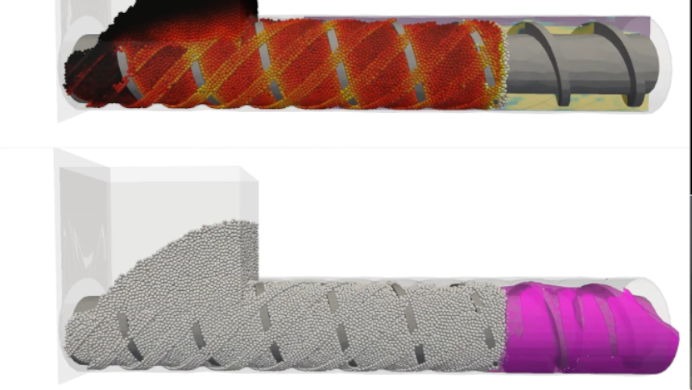
Melting and conveying of polymer granules, and cohesive paste extrusion with the Edinburgh model.
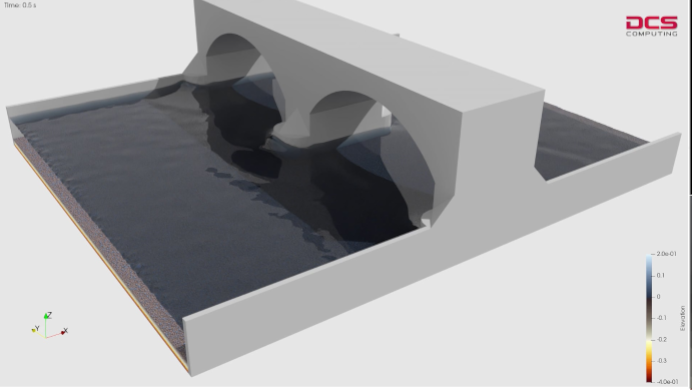
Scour around bridge foundations with two-phase river flow and millions of sediment parcels.
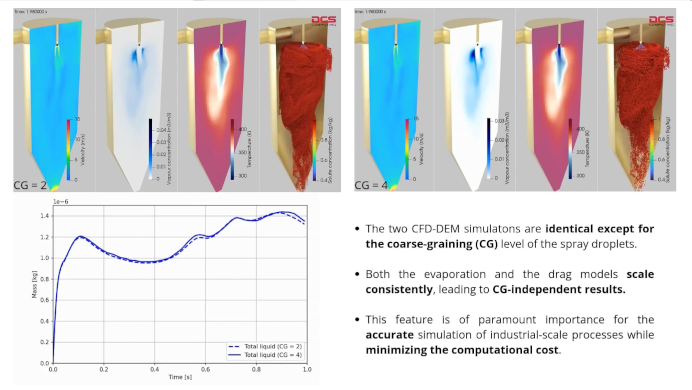
Coarse-grained droplets keep industrial spray drying accurate at manageable cost.
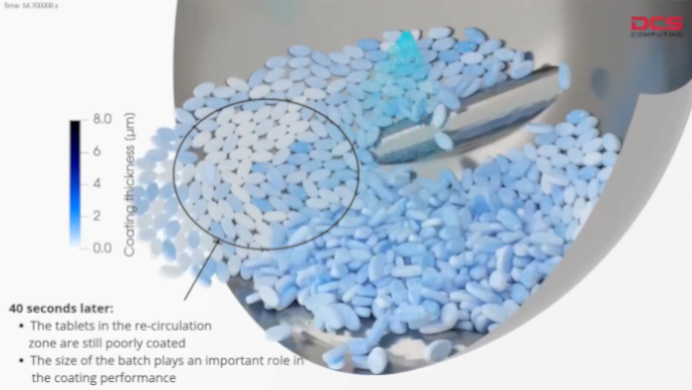
Spray deposition on a moving tablet bed: tablet shape, drum speed and nozzle setup compared.
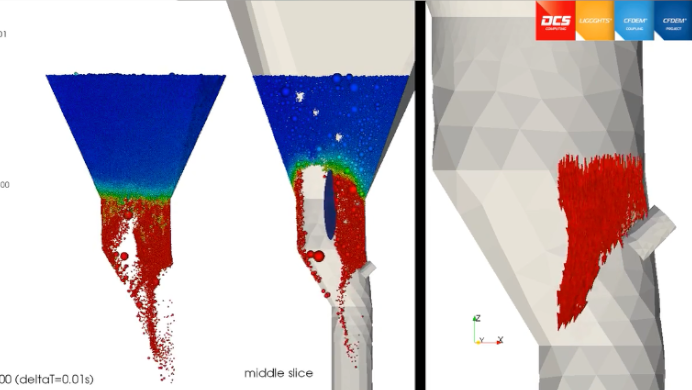
Segregation of a blend in a commercial-scale tablet press feed system.
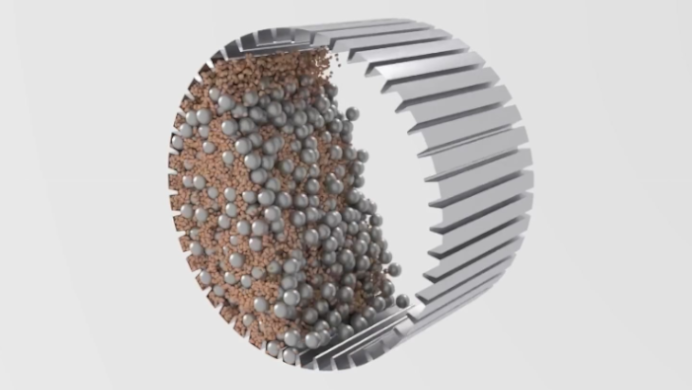
Liner and lifter wear calculated with Finnie's model while the geometry wears down over time.
No case study matches all selected filters.
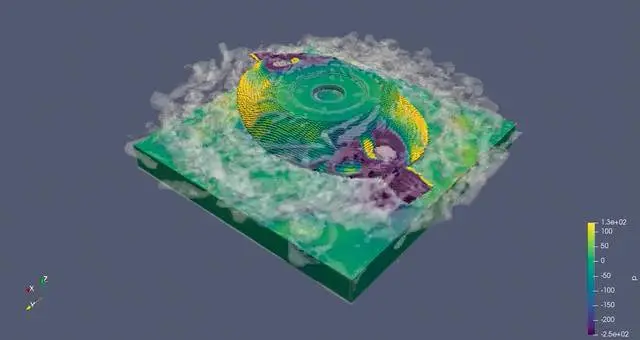
Together with PÖTTINGER Landtechnik, DCS Computing simulated the air flow in a mower deck whose rotating blades sweep overlapping paths, compared design variants for better cut quality, and modelled grass as flexible fibres.
Customer
PÖTTINGER Landtechnik GmbH
Question
Which deck geometry and boundary conditions give the air flow for the best cut quality?
Method
Immersed boundary model for the blades in CFDEM®coupling; grass as multisphere fibres in Aspherix®
Validation
Checked against a sliding-mesh solution; air flow rates correspond to the available experimental data
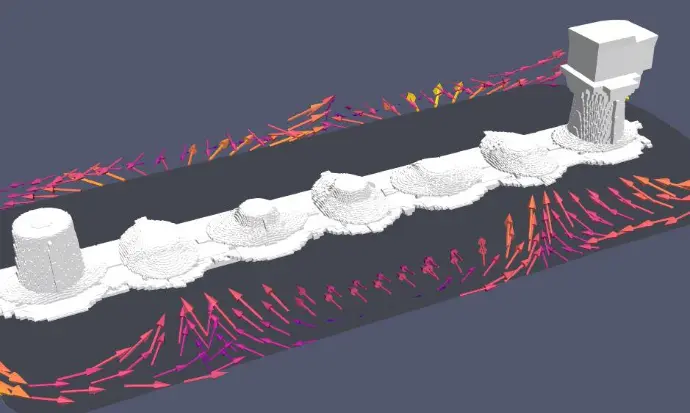
A mower deck carries several rotating blades side by side. Their paths intersect, so the space each blade sweeps overlaps with its neighbours. The air flow these blades create influences how the grass is cut, and PÖTTINGER wanted to improve cut quality by optimising the deck.
The standard way to simulate rotating parts in CFD is the sliding mesh: each rotor gets its own mesh zone that turns with it. That only works when the zones do not overlap. For intersecting blade paths, sliding mesh is not applicable, so a different approach was needed.
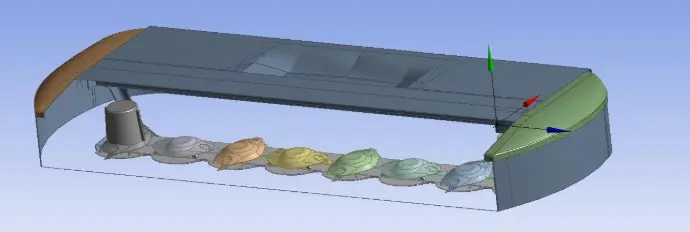
DCS Computing modelled the moving blades with an immersed boundary (IB) technique developed specifically for mower deck applications in CFDEM®coupling. The blades move through a fixed fluid mesh instead of carrying their own mesh, so intersecting paths are no longer a problem.
Before using it for design work, the method was validated against a sliding-mesh simulation of a configuration where both approaches can be applied.
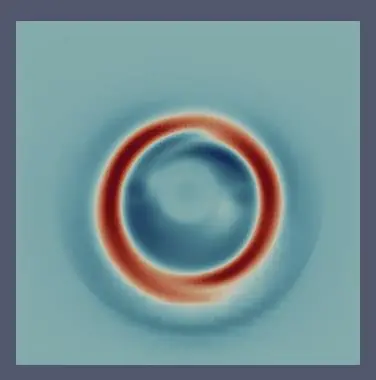
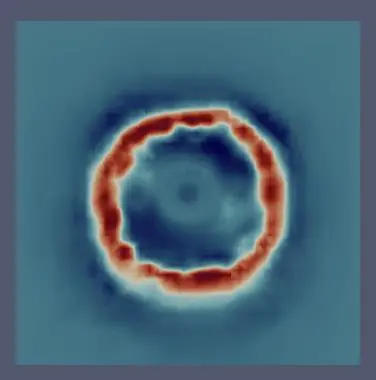
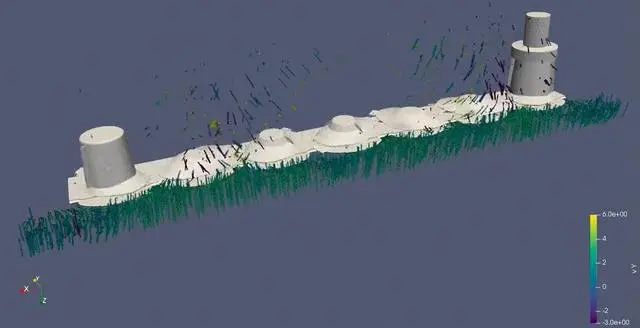
Validation of the immersed boundary method against sliding mesh.
With the validated model, different deck geometries and boundary conditions were investigated and optimised. For each variant, the simulation tracks the air flow rate over time through the sides, the inlet and the outlet of the deck. The simulated data corresponds to the experimental data available.
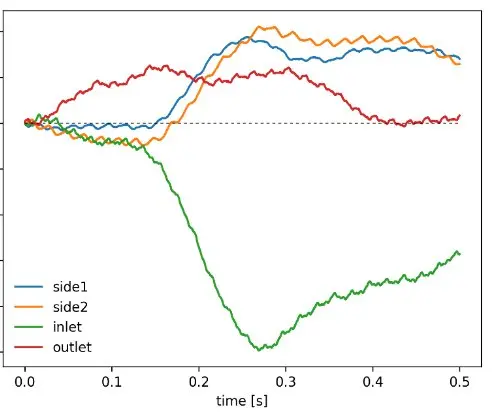
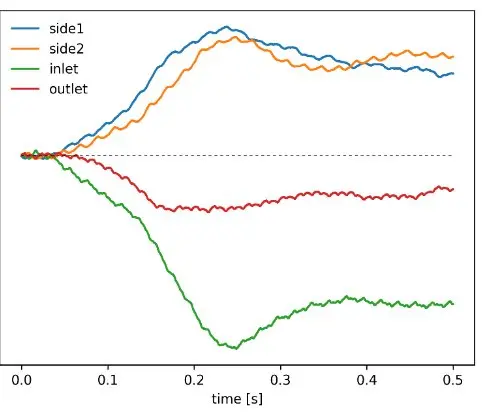
Two setups compared: air flow rate at the deck boundaries over time.
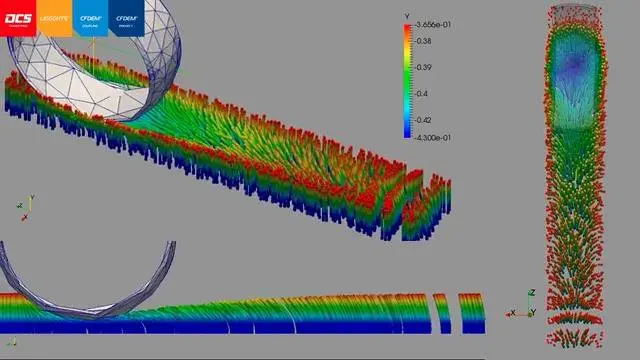
In Aspherix® DEM software, grass leaves are modelled as fibres made of multisphere bodies with elastic and damping forces between the spheres, in normal and tangential direction. When a wheel rolls over them, the fibres bend and then move back towards their original shape.
In CFDEM®coupling, these flexible fibres can be cut and coupled to the complex air flow in the mower deck. This links the air flow directly to what happens to the grass.
“With DEM being a relatively new and emerging method (compared e.g. to the Finite Element Method), it was very important for us to collaborate with a highly knowledgeable, reliable but also responsive software partner. We are pleased to say that DCS Computing has been living up to those expectations for years and are looking forward to more exciting projects together in the future.”
Josef Bruckner, PÖTTINGER Landtechnik GmbH
The immersed boundary approach suits any machine with rotating tools whose paths overlap. These pages show related work:
Immersed boundary CFD-DEM of grain separation over a moving chaffer. See the agricultural machinery cases.
How material parameters are matched to lab tests. See the calibration workflow.
Immersed boundary, AMI and moving meshes. Explore CFDEM®coupling.
A sliding mesh gives each rotor its own rotating mesh zone, and the zones must not overlap. In a mower deck the blade paths intersect, so the zones would overlap. An immersed boundary model moves the blades through a fixed mesh and avoids this limitation.
It was validated against a sliding-mesh simulation of a configuration where both methods apply. In the design study, the simulated air flow rates corresponded to the experimental data available.
Yes. In Aspherix®, grass leaves are modelled as flexible fibres made of multisphere bodies with elastic and damping forces between the spheres. In CFDEM®coupling the fibres can be cut and coupled to the air flow.
Talk to the engineers who built this model about your design question.
This simulation shows a wet-cake undergoing agitation and evaporation in a lab-scale agitated filter dryer where the filter chamber is heated. The powder's cohesivity changes dynamically with the residual solvent content, affecting the rheology of the wet-cake.
Aspherix® and CFDEM®coupling allow for the advanced simulation of complex multi-phase fluid flows through granular media. By leveraging an integrated Volume-of-Fluid (VoF) method combined with immersed boundary techniques, the software precisely captures the dynamic interactions between liquids, gases, and highly realistic convex particles. This high-fidelity digital twin setup enables engineers to track fluid advancement and identify localized phenomena, such as trapped air pockets, within porous structures. Ultimately, this predictive workflow empowers R&D managers to optimize liquid distribution systems, improve process reliability, and mitigate costly phase-separation inefficiencies.
Aspherix® and CFDEM®coupling allow for the high-fidelity simulation of complex fluid-particle interactions within the continuous casting mold. By integrating advanced solvers for steel flow and argon bubble dynamics, engineers can accurately model the behavior of inclusions under the influence of electromagnetic fields and turbulent flow. This integrated workflow enables the precise prediction of bubble entrapment and non-metallic inclusion distribution, providing a predictive digital twin that allows R&D managers to optimize nozzle designs and significantly reduce surface defects in the final product.
The setup is inspired by Wang et all. 2024 (Entrapment behavior of argon bubbles and non-metallic inclusions under combined magnetic fields in slab continuous casting).
Design of future battery materials is a big challenge! Battery performance crucially depends on packing properties. We are modelling the paste as particles in an electric potential. The material experiences heating due to the electric current.
Aspherix® and CFDEM®coupling allow for the high-fidelity simulation of the complex internal dynamics of a blast furnace, from layer-by-layer material charging to the intense fluid-particle interactions at the tuyeres. By utilizing advanced non-sphericity treatments—including calibrated rolling friction models and laser-scan-derived multisphere particles—engineers can precisely predict the particle flow profile and permeability of the burden. This integrated workflow provides a predictive digital twin, enabling R&D managers to optimize the charging cycle and hot blast distribution, ultimately improving thermal efficiency and reducing fuel consumption in hot metal production.
Aspherix® and CFDEM®coupling allow for the detailed simulation of heat and mass transfer within a blast furnace environment. The software's ability to handle convex-shaped particles ensures a realistic representation of ore and coke behavior as they descend through the furnace. As particles are exposed to high-temperature gas sources, Aspherix® captures the transition from solid to liquid, modeling the accumulation of molten mass in the hearth. This integrated approach provides critical insights into the internal state of the furnace, helping engineers optimize fuel consumption and improve the stability of the melting process.
Simulation of a bucket wheel apparatus that is fed a continuous stream of a slightly cohesive polydisperse particle mixture. The bucket wheen deposits the particles onto a sloped conveyer belt via a funnel mechanism.
Aspherix® and CFDEM®coupling allow for the high-fidelity simulation of complex sediment transport and wave-induced erosion processes. By precisely modeling fluid-particle interactions and multi-phase hydrodynamics, our solution tracks exact particle displacement and beach morphology changes under dynamic wave loads. This integrated workflow captures critical physical behaviors like sub-surface movement and localized structural wear without relying on empirical guesswork. Ultimately, this predictive digital twin empowers principal engineers to design resilient coastal infrastructure, mitigate environmental impact, and significantly reduce long-term maintenance costs.
With rising water levels dams may fail. This conceptual study shows that the change of the water level impacts on the stability of the dam. While for the lower water level the dam remains stable, instabilities show when it is higher.
Aspherix® and CFDEM®coupling allow for the high-fidelity simulation of dynamic debris flow and structural clogging at hydraulic control barriers. By utilizing the advanced multisphere method in Aspherix® to accurately represent various complex geometries of floating log wood, the digital twin framework captures realistic structural entanglement. On the fluid side, an integrated Volume-of-Fluid (VoF) solver in CFDEM®coupling models the underlying transient water flow, creating a fully coupled hydro-mechanical feedback loop. Ultimately, this predictive workflow delivers critical insight into blockage thresholds, enabling principal engineers to optimize weir design geometries, mitigate flooding risks, and safeguard downstream infrastructure reliability.
Simulation of the dragline bucket of a Liebherr HS8100.2 crawler crane excavating gravel. The bucket and the spreader bar are modeled as 6-degrees-of-freedom (6-dof) geometries, while the chains and ropes are modeled as bonded spherical particles. The motion of the assembly is controlled by translating the hoist coupler and to the drag coupler. The drag rope can slide on the pulley of the hoist coupler and therefore control the tilting of the bucket.
CAD geometry of the bucket from “1/14 scale dragline bucket for liebherr hs 855 or 8100” by raoul00123 on cults3d.com - Licensed under CC BY.
Aspherix® and CFDEM®coupling allow for the high-fidelity simulation of complex aerosolization and particle detachment processes within dry powder inhalers. By utilizing fully coupled fluid-particle and particle-particle interactions (four-way coupling) executed efficiently on the GPU, the software functions as a predictive digital twin capable of managing massive scales, such as one million particles within a one million cell CFD mesh. This integrated workflow enables engineers to precisely analyze how airflow shear forces release the API from coated particles, providing the critical optimization insights needed to maximize lung deposition, enhance dosing consistency, and accelerate regulatory approval cycles.
Aspherix® allows for the high-fidelity simulation of triboelectric charging dynamics and near-field electrostatic particle interactions in complex hopper geometries. By capturing contact electrification and resulting particle-to-particle repulsive forces, the software delivers accurate insight into electrostatic dispersion, agglomeration, and flow behavior. R&D teams can systematically evaluate wall contact interactions, surface charge accumulation, and electric field impacts—enabling engineers to eliminate unintended electrostatic clogs, optimize powder feeding uniformity, and enhance product quality across automated bulk handling processes.
This video shows a full-coupled CFD-DEM simulation of a fluidized bed granulation process. A liquid-solid mixture is sprayed into the granulator (see droplets in magenta) from a nozzle. The liquid and solid species are deposited onto the carrier particles and, partially, onto the granulator walls. The product quality (between 0 to 1) measures the coating/granulation level of the carrier particles. Finally, the temperature field changes dynamically due to the heating from the fluidization air and the cooling due to the liquid evaporation.
This video shows a DEM simulation of a rotary kiln processing a bulk material. The mixing efficiency and the residence time distribution are two important KPIs that can be predicted with accuracy using DEM.
Aspherix® and CFDEM®coupling allow for the advanced multi-phase simulation of complex crop separation and sieving processes. By utilizing the cutting-edge Immersed Boundary (IB) technique, engineers can seamlessly integrate arbitrary, high-frequency geometric motions—such as the complex wiggling of a harvester's chaffer—directly into the fluid-particle flow. Powered entirely by GPU acceleration, this digital twin accurately tracks the interaction of nearly a million particles alongside dynamic fluid meshes to model realistic segregation and sieving behavior. This integrated workflow delivers a high-fidelity predictive tool, enabling R&D managers to maximize grain throughput, minimize crop loss, and accelerate the development of next-generation agricultural equipment.
Aspherix® and CFDEM®coupling allow for the high-fidelity simulation of melting processes in multi-phase environments, such as HBI ingots within a liquid steel and slag crucible. By leveraging advanced heat transfer models and density-driven buoyancy, the software accurately predicts how solid particles interact at the slag-liquid interface while subjected to magnetic field-induced stirring. This digital twin approach tracks the mass evolution of particles as they phase-change into the liquid melt, providing predictive insights into thermal efficiency. This enables R&D managers to optimize melting cycles, refine energy consumption, and ensure superior chemical homogeneity in metallurgical vessels.
Aspherix® allows for the high-fidelity simulation of industrial-scale bulk solids mixing within complex geometries like helical mixers. By leveraging advanced GPU acceleration, the software can effortlessly track the individual dynamics and multi-body contacts of over one million multi-sized particles simultaneously. This predictive digital twin enables engineers to precisely evaluate critical parameters such as blend homogeneity, segregation risks, and particle transport rates under varying operational speeds. The resulting integrated workflow gives R&D managers the exact insights needed to optimize mixer blade design, minimize cycle times, and drastically reduce the energy consumption of large-scale blending operations.
Twin-screw extruders (TSEs) are widely used for processing polymers, chemicals and foodstuff. Development of a 1D-3D model for polymer extrusion in TSE (collaboration with Novartis*). The 3D part consists of DEM simulations of representative volume elements (RVEs). The 1D part is a low-order model bridging the solution between the RVEs
*https://www.aiche.org/academy/conferences/aiche-annual-meeting/2022/proceeding/paper/45f-3d-1d-modelling-twin-screw-extruders
Aspherix® and CFDEM®coupling allow for the high-fidelity simulation of multi-phase thermochemical processes, seamlessly integrating fluid dynamics, particle motion, and chemical kinetics. By capturing the intricate interplay of gas-phase hydrogen fluidization, heat transfer, and heterogenous chemical reactions, the software creates a predictive digital twin of the reduction furnace. This integrated workflow enables engineers to precisely evaluate the initial stages of hematite reduction, optimize gas consumption, and minimize trial-and-error prototyping, ultimately accelerating the scale-up of sustainable steelmaking technologies.
The active material is represented by the large dark particles, while the additive material as small bright ones. The presence of a binder material is modeled by the formation of bonds between active and additive materials. The height of the layer after calendaring is around 30% lower than the initial one due to bond formation.
Aspherix® allows for the high-fidelity simulation of complex granular transport mechanisms operating under extreme environmental conditions, such as the low-gravity environment of the Moon. By precisely capturing the non-spherical particle shapes of lunar regolith and simulating the complex "stick-slip" phenomenon, the software serves as a predictive digital twin to evaluate static friction counteraction and upward material flow. This integrated workflow enables R&D managers and aerospace engineers to optimize the mechanical reliability of transport systems like the Vertical Lunar Regolith Conveyor (VLRC), significantly reducing physical prototyping costs and ensuring mission success for extraterrestrial infrastructure development.
The animation shows the flow of 5 micron sized evaporating droplets flowing through the nasal airways during a respiration cycle using Aspherix® DEM software. The air flow information is pre-calculated using CFD and the transient flow field is imported to Aspherix®.
Aspherix® and CFDEM®coupling allow for the high-fidelity simulation of fine pharmaceutical powders within large-scale fluidized bed reactors. Leveraging advanced GPU-acceleration and sophisticated particle coarse-graining techniques, the software serves as a high-speed digital twin capable of tracking hundreds of thousands of fine particles and complex fluid-particle interactions simultaneously. This predictive, integrated workflow enables R&D managers to precisely analyze powder distribution and flow behavior without compromising computational efficiency. Ultimately, these insights allow engineering teams to optimize process stability, reduce cycle times, and ensure consistent product quality in demanding production environments.
Aspherix®
allows the simulation of soil plowing and equipment wear. Aspherix® features a large model library that allows to reproduce the complex soil rheology, as well as the wearing. The selection of model parameters plays a paramount role as well, therefore DCS Computing developed Aspherix®
Calibration, a module designed for the calibration of DEM model parameters.
Aspherix® and CFDEM®coupling allow for the high-fidelity simulation of dynamic riverbed erosion and sediment transport. By integrating a coupled Volume-of-Fluid (VoF) and Discrete Element Method (DEM) approach, the software precisely captures the transient hydrodynamic forces acting on individual sediment particles. This predictive digital twin workflow enables engineers to model multi-phase fluid-particle interactions and track changing bed morphology under varied flow rates without relying on simplified empirical models. Ultimately, this advanced simulation framework empowers principal engineers to safeguard hydraulic infrastructure, design resilient river management strategies, and minimize environmental impact.
This video shows a model of a rotary cooler, realized with CFDEM®coupling. A hot particle stream enters through a transfer chute into the slightly inclined and rotating cooler.
Aspherix® allows for the high-fidelity simulation of powder dosing and multi-stage compaction processes within industrial rotary tablet presses. By capturing precise particle-scale dynamics during punch compression, the software predicts density distributions, force transmission, and potential compaction defects in the final tablet geometry. R&D teams can systematically evaluate punch mechanics, powder behavior, and operating speeds—enabling engineers to accelerate formulation design, ensure structural tablet quality, and prevent costly manufacturing defects during scale-up.
Aspherix® and CFDEM®coupling enable the precise simulation of scrap melting and thermal dynamics in steel converters. Featuring a comprehensive physics library, the software accurately reproduces phase-change kinetics, heat transfer, and the resulting fluid-particle interactions. Because the accuracy of these metallurgical insights depends on reliable input data, DCS Computing provides specialized tools for the calibration of complex material properties, ensuring simulations reflect real-world furnace conditions with high fidelity.
An extruder is transporting and melting polypropylene granules (particles: white spheres, molten plastic: purple iso-surfaces). The interplay between solid, air and liquid is obtained by coupling Aspherix with cfdemSolverInterDyMPC. The melting is reproduced by a mass transfer from solid to liquid, which occurs when the particle temperature exceeds the melting point due to external heating.
Simulation of paste extrusion where the Edinburgh model is used to model cohesion.
Aspherix® and CFDEM®coupling allow for the high-fidelity simulation of large-scale sediment erosion and scour formation around critical infrastructure. By utilizing an integrated Volume-of-Fluid (VoF) solver paired with advanced drag correlations, the software accurately captures the complex coupling between turbulent two-phase river flows and millions of multi-sized discrete sediment parcels. This high-performance digital twin environment allows engineers to safely model real-scale hydrodynamics and collective particle behaviors under varying seasonal flow conditions. Ultimately, this predictive workflow delivers actionable insights into structural risk, enabling asset managers to optimize preventative maintenance and guarantee long-term operational reliability.
This video shows how CFD-DEM simulations of spray drying processes are insensitive to the coarse-graining level of the spray droplets. This allows to simulate industrial-scale problems by keeping the particle's count, and therefore the computational cost, at a manageable level without sacrificing accuracy.
Aspherix® allows for the high-fidelity simulation of intra-particle spray droplet deposition on moving particle beds during pharmaceutical coating processes. By leveraging advanced contact models, support for complex non-spherical tablet geometries, and precise spray interaction models, the software captures detailed coating mass distribution across batch charges. R&D teams can systematically evaluate the impact of tablet shape, drum rotation speed, and spray nozzle configuration, enabling engineers to eliminate coating defects, accelerate scale-up, and maximize batch yield.
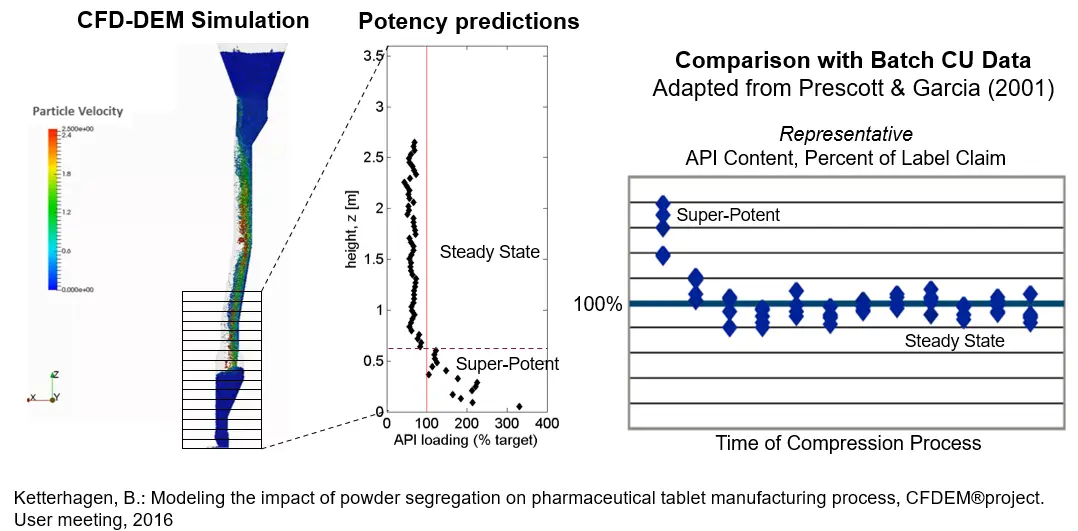
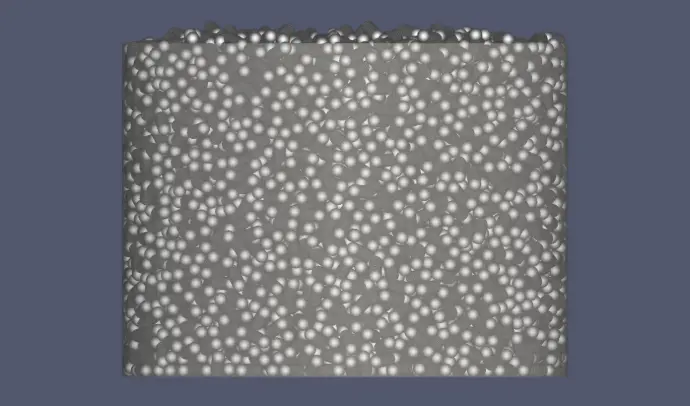
Simulation of commercial scale tablet press feed system with a coupled CFD-DEM model.
The simulation shows a ball mill's section where a mix of steel balls (grey spherical particles) and rocks (brown non-spherical particles) is processed. The wear of the internal surface (plates and lifters) is calculated based on the Finnie's model and the eroded volume is used to dynamically deform the geometry.
Not every study starts with a machine. In these notes, customers and research groups share results on modelling questions that matter in many applications: particle shape, calibration and fluid forces on non-spherical particles.
Arizona State University · Research
A virtual calibration chamber matches a documented cone penetration test, then shows why an expanding shaft makes penetration easier.
Procter & Gamble · Method study
Three or more spheres reproduce the bulk behaviour of a spherocylinder in seven tests. More spheres damp multi-contact collisions and need a smaller time step.
University of Edinburgh · Research
Modelling flat bentonite particles as spheres over-predicts how deep slurry infiltrates the soil. Flat particles build a filter cake near the surface.
No case study matches all selected filters.
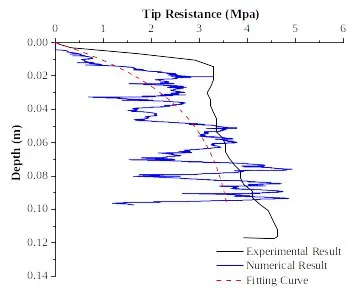
Key finding: a virtual calibration chamber built in Aspherix® reproduces the tip resistance of a documented cone penetration test (CPT) in Ticino sand, and then shows how a shaft that expands and contracts makes penetration easier. Julian Tao, Associate Professor at Arizona State University, ran the study himself after trying the software.
DEM has become a major research tool in geomechanics. Once it is validated, it gives quantitative insight across scales, from single contacts to the whole sample. Virtual calibration chambers are an established idea, but they are rarely used to study penetrators with different shapes, complex movements and at various scales. Prof. Tao's group had used LIGGGHTS® and CFDEM® before to study internal and surface erosion; for this study they used Aspherix®.
“It offers more user friendly options to install and run the program, especially with the GUI. This can significantly flatten the learning curve for new students.”
Julian Tao, Associate Professor, Arizona State University
A 3D virtual calibration chamber was built in which the initial soil state, relative density and stress, is prepared with established methods (O'Sullivan 2011). The model was checked against a well-documented CPT in Ticino sand (Butlanska et al. 2010). With suitable parameters, the simulated tip resistance agrees very well with the measured values. The fluctuations in the simulated curve come from the limited number of contacts between the cone and the particles.
Matching a simulation to a lab or field test like this is the core of every reliable DEM model. See the calibration workflow in Aspherix®.
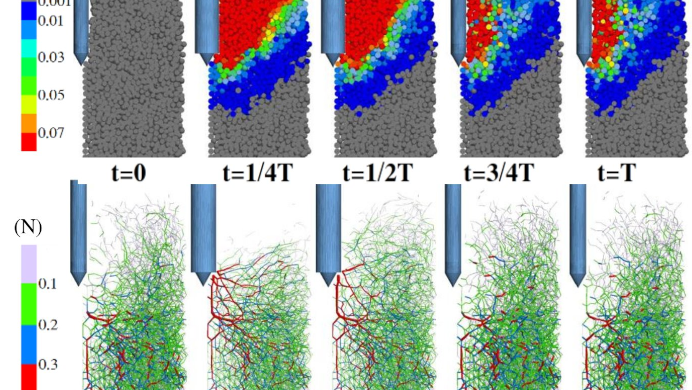
The dynamic penetrator has a cylindrical shaft and a conical tip. One cycle has four steps: the shaft expands, the tip penetrates, the shaft contracts to its original diameter, and the shaft follows. The simulation ran at an expansion and contraction frequency of 5 Hz.
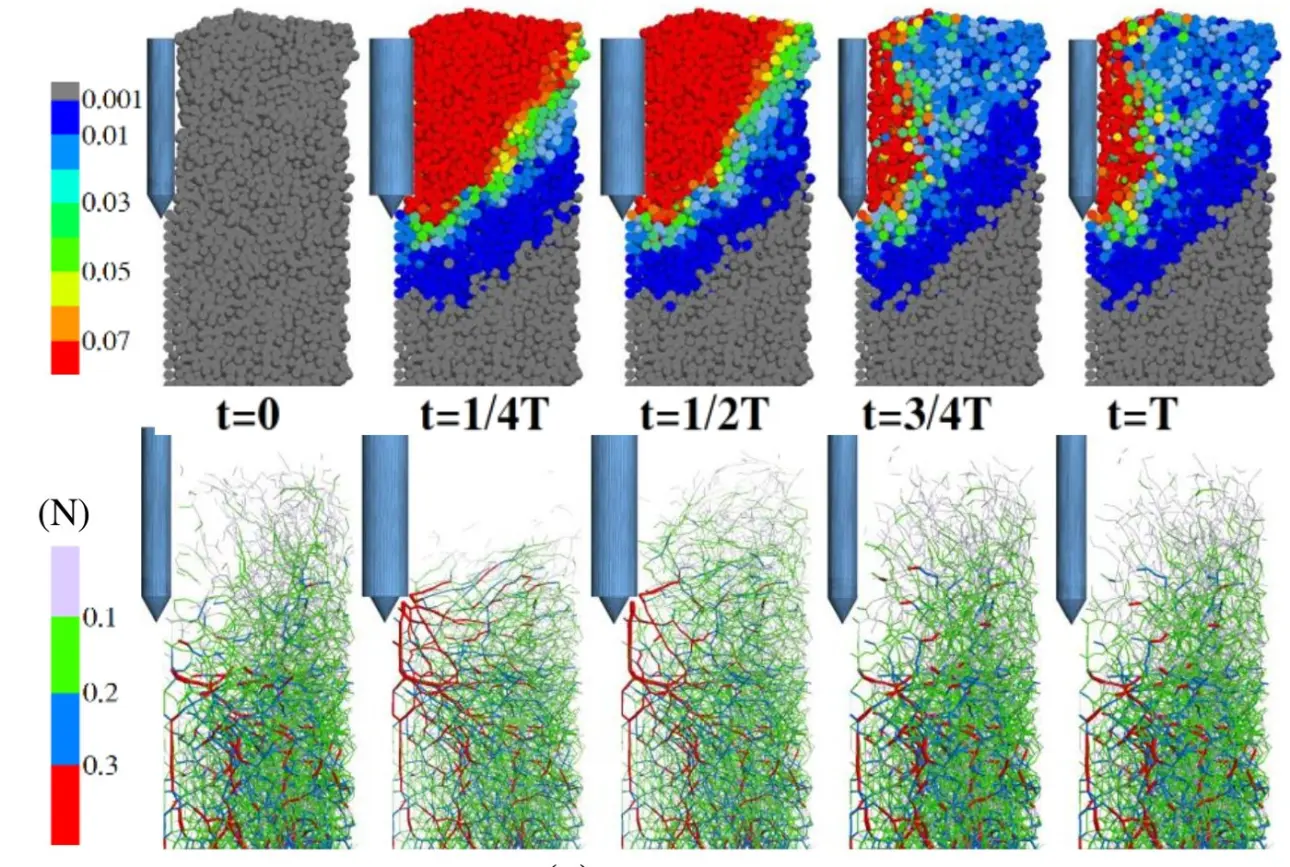
The displacement fields and force chains explain why this works. The expanding shaft pushes the soil sideways and opens space around the cone, so the cone penetrates more easily than in a standard CPT. When the shaft contracts, the particles lag behind and leave a small gap, which lowers the resistance as the shaft moves down. Downward penetration therefore needs less force than direct penetration, at the cost of the energy for expanding the shaft.
Beyond these pictures, the simulation delivers particle trajectories and velocities, stress and strain at the meso scale, and contact and friction forces between particles and penetrator.
The same workflow applies to other soil–tool interaction problems. Universities can license Aspherix® on academic terms: see Aspherix® Academic. For related industrial work, see the civil and hydraulic engineering cases.
Study and results: Julian Tao, Arizona State University (user report, January 2023). Published with permission.
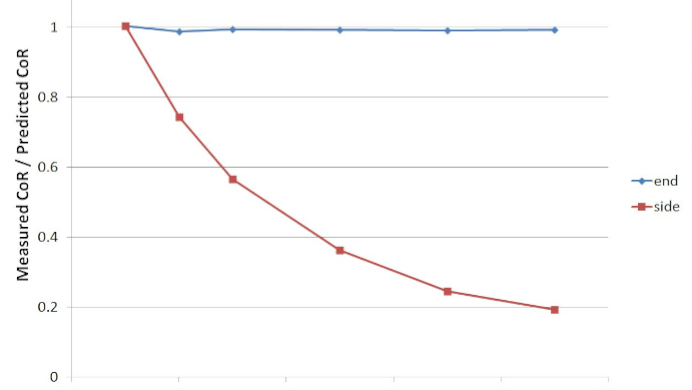
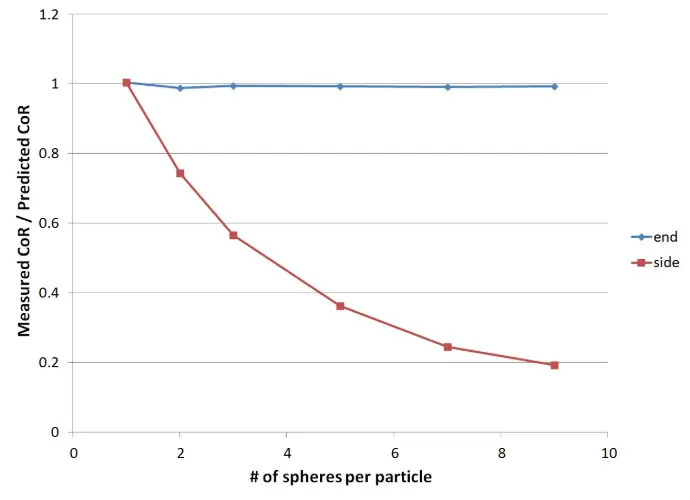
Short answer: three spheres or more reproduce bulk behaviour such as angle of repose, hopper flow and mixing for a spherocylinder particle. More spheres improve the shape but strongly damp collisions with several contact points and need a smaller time step. That is the result of a systematic study by Procter & Gamble, who compared 2- to 9-sphere particles in seven tests.
Multisphere (clumped sphere) particles are a common way to represent non-spherical grains in DEM: overlapping spheres are glued together into one rigid body. The more spheres, the closer the surface comes to the real shape, but each extra sphere adds contacts and cost. P&G wanted to know where the trade-off lies.
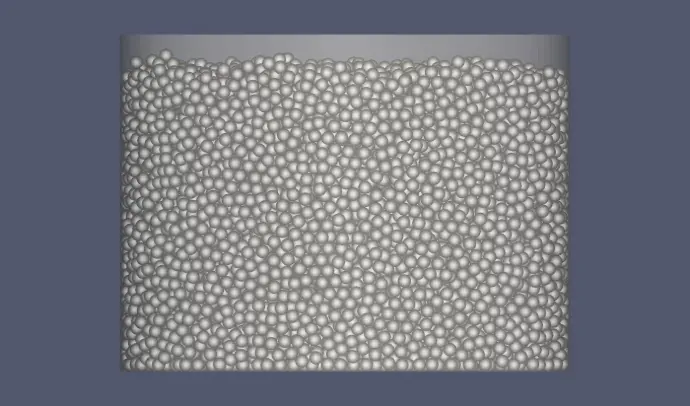
All tests used a spherocylinder (a cylinder with hemispherical caps, cylinder height twice the cap radius), represented by 2, 3, 4, 5, 7 or 9 equal spheres spaced evenly along its axis.
| Test | Setup | Finding |
|---|---|---|
| Bounce | Single particle dropped on its end (1 contact) and on its side (several contacts) | End drops: restitution within 1% of the set value. Side drops: restitution falls with every sphere added, to ≈ 20% of the set value at 9 spheres |
| Packing | 10,000 particles in a 1 L cup | Packing fraction converges from 4–5 spheres on, ≈ 0.59 |
| Angle of repose | 10,000 particles in a narrow slot | 3 to 9 spheres give the same heap profile; 2 spheres match the peak but not the flanks |
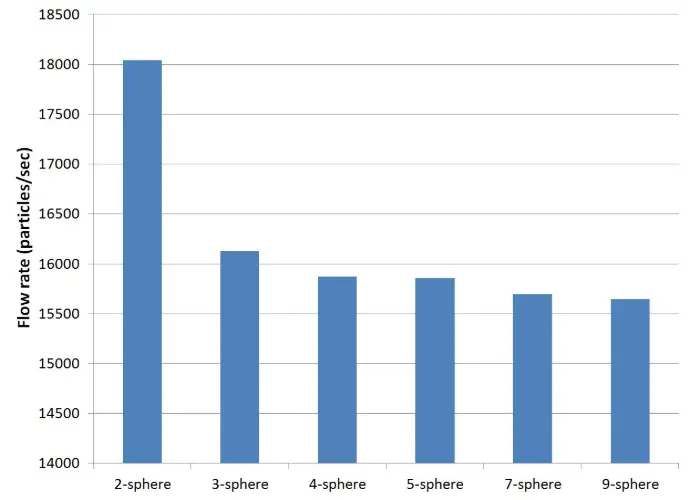
| Hopper flow | 100,000 particles | 2-sphere particles flow ≈ 12–15% faster; 3 to 9 spheres agree within a few percent |
| Paddle mixer | 100,000 particles, Lacey mixing index | Same mixing curve for all; 7 and 9 spheres need ½ and ¼ of the time step |
| Vibrating helical conveyor | Particle stream, hold-up over time | Hold-up by particle count differs, by mass it collapses onto one curve |
| Continuous mixer | Particle stream, hold-up over time | Not conclusive yet; longer runs and smaller time steps under way |
Where the contact behaviour itself matters, Aspherix® offers superquadric shapes, which describe a smooth surface with a single contact point per pair. See the particle shapes in the Aspherix® features, or see the calibration workflow for matching restitution and friction to lab tests.
Study and data: Procter & Gamble. Published with permission. Read what our customers say in our references.
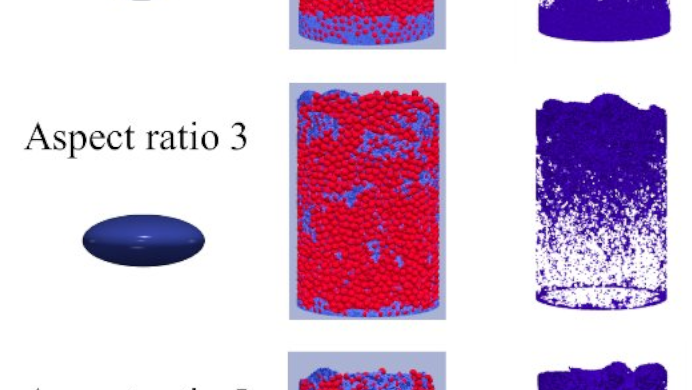
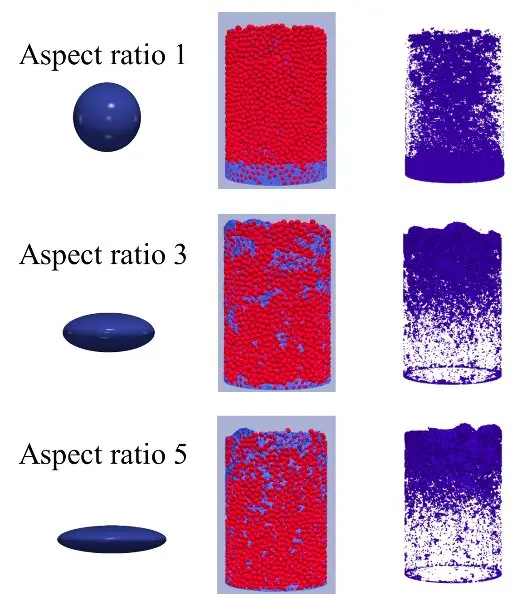
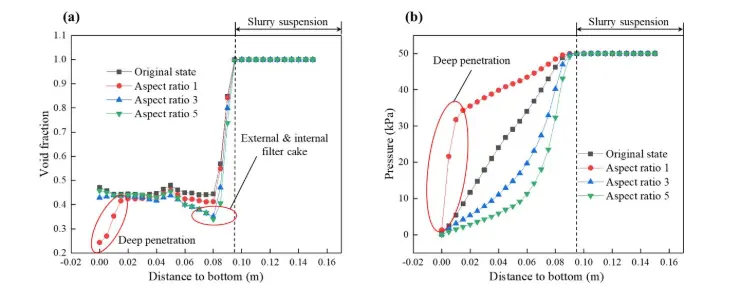
Key finding: modelling bentonite slurry particles as spheres over-predicts how deep they infiltrate the soil. Flat, non-spherical particles clog near the surface and build an external filter cake. Jiayuan Liu and Kevin J. Hanley at the University of Edinburgh showed this with coupled CFD-DEM in Aspherix® and CFDEM®coupling.
Slurry shield tunnelling is often used for undersea tunnels. It relies on a filter cake of low permeability that forms where the slurry meets the soil at the tunnel face. Earlier CFD-DEM studies of this process represented the bentonite in the slurry as spheres. Real bentonite, however, consists of flat clay platelets, and particle shape strongly affects packing. The research, part of a PhD project on slurry infiltration in granular soils, asked how much the shape changes the result.
Spherical slurry particles penetrate deep into the sand column. With aspect ratios 3 and 5, the particles clog the upper part of the column and form external and internal filter cakes. Near the top of the column, the void fraction is clearly lower than with spheres, and the pressure drop moves towards the sand surface as the aspect ratio grows.
“Using spherical particles to represent what in reality are non-spherical particles leads to an over-prediction of infiltration distances in the simulations.”
Jiayuan Liu and Kevin J. Hanley, University of Edinburgh
Next, the team will extend the study to more aspect ratios, vary the size ratio between sand and slurry particles and analyse how the spheroids orient within the filter cake.
Whenever fine particles are flat or elongated, spheres can give the wrong answer, here on how far slurry penetrates the ground. Aspherix® and CFDEM®coupling combine superquadric shapes with shape-aware fluid forces, so the particle shape can be part of the model. See CFD-DEM with CFDEM®coupling, or browse the civil and hydraulic engineering cases.
Research and results: Jiayuan Liu and Kevin J. Hanley, School of Engineering, University of Edinburgh. Published with permission. The pitching torque implementation was presented by O. Erken at the 4th Aspherix® & CFDEM® Conference, Linz, April 2023.
Every case study above started with a question like these.
Pfizer used a coupled CFD-DEM model of the full feed system.
Digital twin with laser-scanned particle shapes and gas-solid heat transfer.
Wear calculated with Finnie’s model; the geometry deforms as it wears.
Immersed boundary model built for this case; results matched the experiments.
Over one million multi-sized particles on GPU.
Four-way coupled CFD-DEM, one million particles in a one-million-cell mesh.
Multisphere logs coupled with free-surface water flow.
Active and additive particles linked by binder bonds; the layer gets about 30% thinner.
Non-spherical regolith and stick-slip behaviour, before any hardware is built.
Tell us about your application and we will show you how Aspherix® and CFDEM®coupling can help.